

Everything is Riven, But All Is Not Lost
A Meditation on Despair, Hope, and the Unfolding of Life

Dear Friends,
Such trying times, such heartache and sorrow, such shock and horror.
May today’s meditation, continuing our series, Toward a Phenomenology of Hope, offer a glimmer.
Following last week’s “Save the Date” announcement for the online weekend retreat, Living in Hope (April 18–19), next week’s letter will offer more details of this intimate gathering.
Wishing you the sustaining comfort that comes in moments of hope,
Renée

Everything is Riven, But All Is Not Lost—A Meditation on Despair, Hope, and the Unfolding of Life
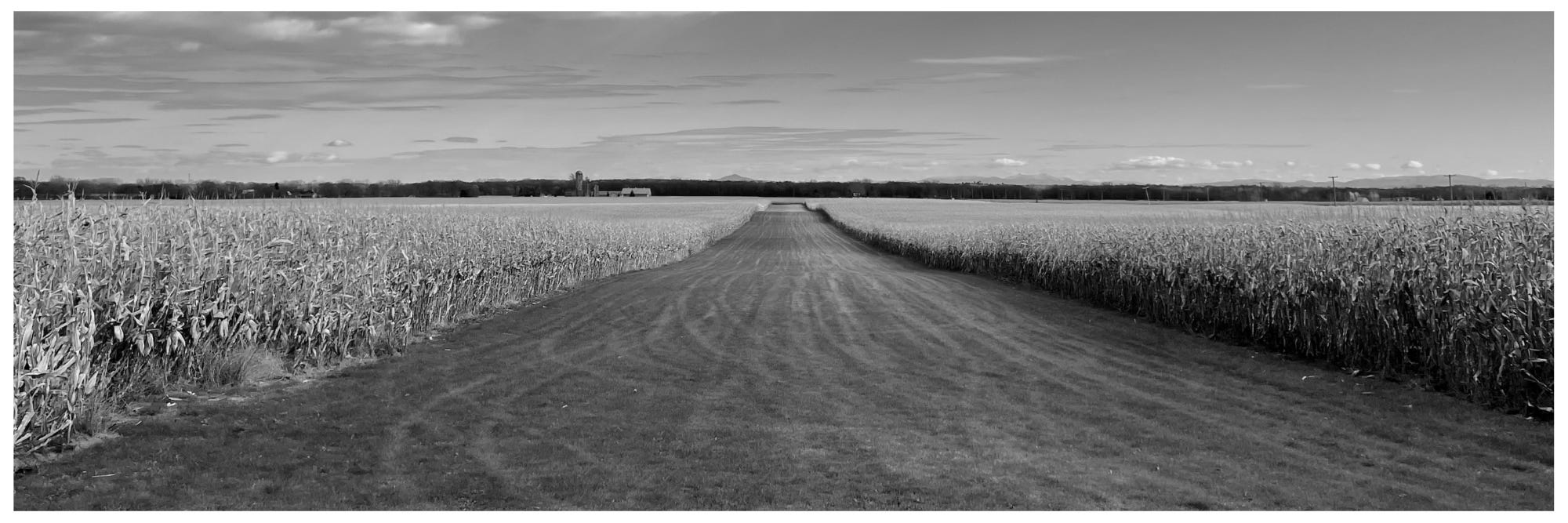
A black strap of freeway cuts across a flat midland stretch of I-40, row upon row of corn sown today for a season reaped tomorrow. Not one row is out of line. Not one stalk falters across a landscape that, from the highway, looks like a military formation in motion, a geometry of obedience, each stalk standing like a soldier drilled from seed to stalk, cropped-even under the August sun.
One by one they will fall.
Long forgotten is the majesty of outstretched plains, tall grasses bending as one body with the whistling rub of wind, thundering hooves, blue sky draping the earth, an openness once wide enough for sound to travel miles. Every mile to my left and my right is a betrayal. Some say more is yet to come if they take the remaining wildlands, too. This is not sweet corn for the dinner table. It is flint corn for feedlots and engine fuel. It will feed human forgottenness, and I, driving this stretch, am complicit, an unwitting participant in the alienation that drives these dynamics. The rows in their obedience stretch toward the horizon as though only one way of ordering this world were imaginable.
And the crude oil not moving through the Strait of Hormuz, in this, too, I am complicit. And the displaced and the wounded, if I perceive or believe their pain and their suffering is not my own, I am complicit, not in the way of that could be me but in the very truth of if one of us is not free, none of us is free. And the young daughters—165 of them at last count—who died on Saturday at school, eyes wide on a blackboard, learning the ligatures of new words, fat pencils in their child hands, as much as I cannot bear it, their last breath under the crushing weight of rubble permeates this world forevermore in its finality. And here I sit in the comfort in my quiet home writing to you, a love song between two cardinals making the melody of a morning, while somewhere not far from here a mother whose skin not the color of this freckled tone prays to God her door will not be pounded down by the blunt barrel of a gun.
Everything is riven.1
Despair would be a natural response. Despair would in some way sidestep for a moment the opacity of a world made by the day more calamitous and unbearable, being that despair has a way of collapsing in on itself, being that despair becomes its own weight to bear, being that it strangely shutters for a time the weight that gave way to it. We are meaning-making beings, after all, and despair is a natural response to that which is abjectly unintelligible. We live in a world that has become abjectly unintelligible.
At certain moments in the unfolding of the human, the world becomes unintelligible by the fact that the way we are conditioned to see it is no longer sufficient for what is emerging.
But hope is not lost. Neither is hope in opposition to despair. We might say that despair is hope occluded. Despair is not the absence of hope. It is hope buried beneath the rubble of meaning that has collapsed—a momentary, if not lengthy, eschatological terminality closed in on itself. Despair seeks to interpret what cannot be interpreted as meaningful. It pleads the pointlessness of the oppressive and interminable weight of it all. It searches the dark convinced that all light has been extinguished.
Too, I sometimes wonder if despair deepens by the fact that we are woefully inept in modernity at allowing inner feeling, at opening our deepest interiority to the pain and sorrow and lamentation of and in service to our aching world.2 This is not a criticism of you and me. It is a recognition of how we are, a glimpse into how we got here, and an invitation: What if we become intimate with what we cannot bear? What if we become beings of conscience?3
We have been reflecting on hope as a spiritual essence always already here, a given openness in the originary Desire to be, which is ever-present across the cosmological and evolutionary arc.4 It precedes us. It is intrinsic to the unfolding of life itself. We have referred to this as ontological hope, hope borne through the compressure by which Being gives birth to being—to existence and life and you and me.5 We have said that this compressure is a narrowing, an inner turning of the Desire to be that remains open to itself. We have said that through this narrowing flares forth the universe, life, we humans. We have also said that through the birth canal of becoming something from nothing, there was anguish, anguish that came long before you and me, and it was the given openness to what is not yet, what we are calling ontological hope, that allowed for the process to continue.
As such, hope is not cultivated in the human so much as it is turned to in our anguish as an essence, a quality of openness to what is not yet, interpenetrating the creative processes of the universe ever-unfolding. We live in hope, as if within the air we breathe.
Who amongst us has not turned to hope in times of sorrow, uncertainty, the unbearable? Even in despair?
We live in an always unfinished world.6 We live in a world endlessly unfolding, a world groping through the dark not yet toward what it is always yet to become. The whole of life forever reaches through the inside perils of its ongoing endeavor to be, risking, like a tree, the outside hazards—the broken branches, the wind-thrown blossoms, and battered leaves. That this is so does not in any way dismiss the immensity of suffering in this world. It asks us to become intimate with it so that such suffering is not for naught but in service to the becoming of all. What we see from these reflections on becoming is that in an evolutionary world, Being is a process of always coming into being—and hope is an intrinsic openness that fortifies the way.
Seen in evolutionary hindsight, it is when the universe, life itself, hence, the human, too, seem to reach an impasse that the process leaps forward. It leaps forward in no small way because there is within existence itself this intrinsic openness, always facing toward what is not yet. Some say the living Earth and human have come to such an impasse, and the task before us now is “making manifest the future which is immanent in ourselves.”7
At such impasse moments, when the prevailing mode of being can no longer bear the pressures placed upon it, something latent begins to break through. Twentieth-century Swiss philosopher Jean Gebser referred to these moments in the human unfolding as mutations of consciousness. Mutational leaps appear when the structure of consciousness itself is no longer adequate.8 What might be named “mutational periods” are thresholds of untold disturbance and destruction. These are moments in the unfolding whereby chaotic upheavals of the existing give way to the latent not yet.9
What we experience today as despair may actually be a signal of a mutation under way.
Something deeper is at work here. What seeks to come into being will establish itself. We are, at most, participants in the unfolding.10 We must not abandon the hope that always already awaits our presence to it.
Living in hope is not unlike the bell in the bell tower of Rainer Maria Rilke’s poem, passages of which I shared at the Winter Solstice 2025: Let this darkness be a bell tower | and you the bell.11 Here, darkness is transfigured into that which sounds the bell; the bell is you and me, sounded by the tension between what is disordered and destructive and what is latent—the “immanent future in ourselves” sounding invisible currents, like wind bending tall grasses of ancient plains, traveling across hill and dale, over horizons not yet seen.
Our task is a humble one, and difficult: to endure the compressive tensions that are becoming evermore acute, without retreating into despair, but bearing the depths of sorrow and lament on behalf of. If we can stay steady, persevering within the pressure as willing participants in the evolutionary unfolding, not as fugitives, the not yet may yet find expression in and through us as vessels of the unfolding.12 For this task, we must sense, feel, and know that we are cared for in the harbor of hope itself.13

All Beyond the Comfort Zone letters and essays will always be free. Paid subscriptions and donations provide financial support for this publication and make it possible to keep all offerings accessible to everyone.
If you have the financial means to support this work, please consider offering a financial contribution today, with my deepest gratitude to you.
Essays in this Series, “Toward a Phenomenology of Hope”
– Toward a Phenomenology of Hope
– Martin Luther King Jr. on Midnight in Our World
– Compressure and the Labor of Hope
– And the Light Shineth in the Darkness
Notes & References
“Everything is riven” is from Patricia M. Zimmerman, “Riven: A Mysticism of Place in Times of Grief,” Journal of Contemplative Studies (February 13, 2025), no. 3, pp. 26–46. https://doi.org/10.57010/XHVK1858
I have written about inner feeling elsewhere, such as here:

P. D. Ouspensky, In Search of the Miraculous: The Teachings of G. I. Gurdjieff—The Classic Exploration of Eastern Thinking and Philosophy (Orlando, FL: Harcourt, 1949, pp. 155–156). Ouspensky’s reflections on conscience and its relationship to consciousness have shaped my own, apropos developing presence to inner feeling. Here is Ouspensky: “In ordinary life the concept of ‘conscience’ is taken too simply. As if we had a conscience. Actually the concept of ‘conscience’ in the sphere of emotions is equivalent to the concept of ‘consciousness’ in the sphere of the intellect. And as we have no consciousness we have no conscience.
“Consciousness is a state in which man knows all at once everything that he in general knows and in which he can see how little he does know and how many contradictions there are in what he knows.
[My note: here he is pointing toward Gebser’s insights on diaphaneity, i.e., “seeing through” in integrality.]
“Conscience is a state in which man feels all at once everything that he generally feels, or can feel. And as everyone has within him thousands of contradictory feelings which vary from a deeply hidden realization of his own nothingness and fears of all kinds to the most stupid kind of self-conceit, self-confidence, self-satisfaction, and self-praise, to feel all this together would not only be painful but literally unbearable.
[My note: I sense from a phenomenology of cardiogenesis work, à la Teilhard, that there is more here than contradictory feelings but that of allowing the impressure of depth of feeling to resonate within the interiority of the heart].
“If a man whose entire inner world is composed of contradictions were suddenly to feel all these contradictions simultaneously within himself, if he were to feel all at once that he loves everything he hates and hates everything he loves; that he lies when he tells the truth and that he tells the truth when he lies; and if he could feel the shame and horror of it all, this would be the state which is called ‘conscience’” (155–156) and “The concept ‘conscience’ [therefore] has nothing in common with the concept ‘morality’” (156).
These reflections can be found in the essay Something Shall Be
These reflections can be found in the essay Compressure and the Labor of Hope

Jean Gebser, The Ever-Present Origin, trans. Noel Barstad and Algis McKunas (Athens, OH: Ohio University Press, 1949/1985), p. 296.
Gebser, Ever-Present Origin.
Ibid.
Ibid.
Rainer Maria Rilke, In Praise of Mortality: Selections from Rainer Maria Rilke’s Duino Elegies and Sonnets to Orpheus, trans. Anita Barrows and Joanna Macy (Brattleboro, VT: Echo Point Books & Media, 2016). This translation is not in the public domain. To read the entire poem online with reprint permission, click here to be taken to Krista Tippett’s On Being.
Gebser, Ever-Present Origin.
“cared for”: see Thomas Berry, The Great Work: Our Way into the Future (New York: Bell Tower, 1999) p. 7.
YES! This is the great insight. Stunningly written Renée. Thankyou friend.
As I walk through the valley of the shadow of death………
… yes … and thank you …