

Something Shall Be
Reflections on Hope as a Potency

Dear Friends,
In today’s meditation, we continue our series, “Toward a Phenomenology of Hope.” Guided by philosopher Asif Rahammim’s hermeneutics,1 we will encounter objectless hope in Paul Celan’s poem, “Komm. . .”. From objectless hope, we’ll press further, opening our purview wide and deep at once, toward ontological hope, a quality imbued in reality itself. The meditation comes to completion with a hope we can live within.
Many of you have written to me in response to the 2026 offerings I outlined in “On Becoming a Shared Work.” If you wish to contribute, please email me: reneeeliphd [AT] gmail [DOT] com. Thank you to you who have already written. It is a joy to imagine our forthcoming online and in-person gatherings.
In hope,
Renée

Something Shall Be
In December 1969, not long after returning to Paris from Israel, Paul Celan—born Paul Antschel—sent the following poem to Ilana Shmueli. They had been childhood friends. Both grew up in Bukovina, Ukraine, before the last World War and “Das, was geschah” (“that which happened”). This is how Celan referred to the Holocaust. It was deliberate circumlocution, walking words around the unspeakable.
In 1944, when Shmueli was twenty, her family escaped to Palestine, but not before her sister, two years older, ended her life. Fleeing the post-war Soviet influence in Bukovina, Celan finally settled in Paris in 1948. He had survived eighteen months of forced labor in a concentration camp. His parents did not.
Celan’s trip to Israel sparked an affair between the two long-time friends, which continued in letters to one another in their native tongue, German, until Celan ended his life in April 1970, four months after penning this poem.2
“Komm. . .”
Es wird etwas sein, später,
das füllt sich mit dir
und hebt sich
an einen Mund
Aus dem zerscherbten
Wahn
steh ich auf
und seh meiner Hand zu,
wie sie den einen
einzigen
Kreis zieht
Something shall be, later,
that fills itself with you
and lifts itself
to a mouth
Out of shattered
madness
I raise myself
and watch my hand
as it draws the one
single
circle
Spare as it is in splintered anguish, this poem is clothed in hope: something shall be.
That this something is not yet namable means that no object has been imaged in Celan’s mind. No claims on outcome have been staked. There is no willed optimism in this something shall be. No practiced positive mindset to lift him from the inner tumult of a world completely shattered; a world collapsed of comprehensibility; a dark abyss absent intelligibility. This is hope before all else, rife with abysses, crevices, and impasses in existence. It is precisely because it rises out of shattered madness, post-catastrophe, that we might linger with Celan’s poem, word by word, line by line, for what it reveals to us today, tremoring as we may be with angst, if not wholly despair.
The poem seems to gesture forward with shall be. But the future tense of shall be may be more about potency than the linear march of time. The something is not known. It cannot be known because it is not yet. The unknown something exerts the pressure of ever-present possibility, while holding the promise of the world in a state of becoming. What is incomprehensible for Celan gives rise to the fundamentally unfinished in the first line of this poem.
So the forward gesture of Celan’s opening line, while it suggests a later event, seems to point toward pressure in the present. The something is latent. And yet, later is already imbued in the immediacy of now. Despite the ominous clouds of uncertainty about what this something shall be, implicit in this poem is not anticipation in the ordinary sense of waiting for what will come. Rather, it seems to be an inner tensile orientation toward what is underway. You can feel it. Shall be is pressing into the immediacy of now, so much so that it fortifies the narrator.
Albeit splintered from himself inasmuch as he can only watch from the outside looking in, now he rises from the shattered madness—from the fragmentation of incomprehensible catastrophe. Something shifts. Reference to a mouth now turns to my hand, even if the narrator is still distant enough that he can only watch. The hand lifting is not experienced so much as it is watched.
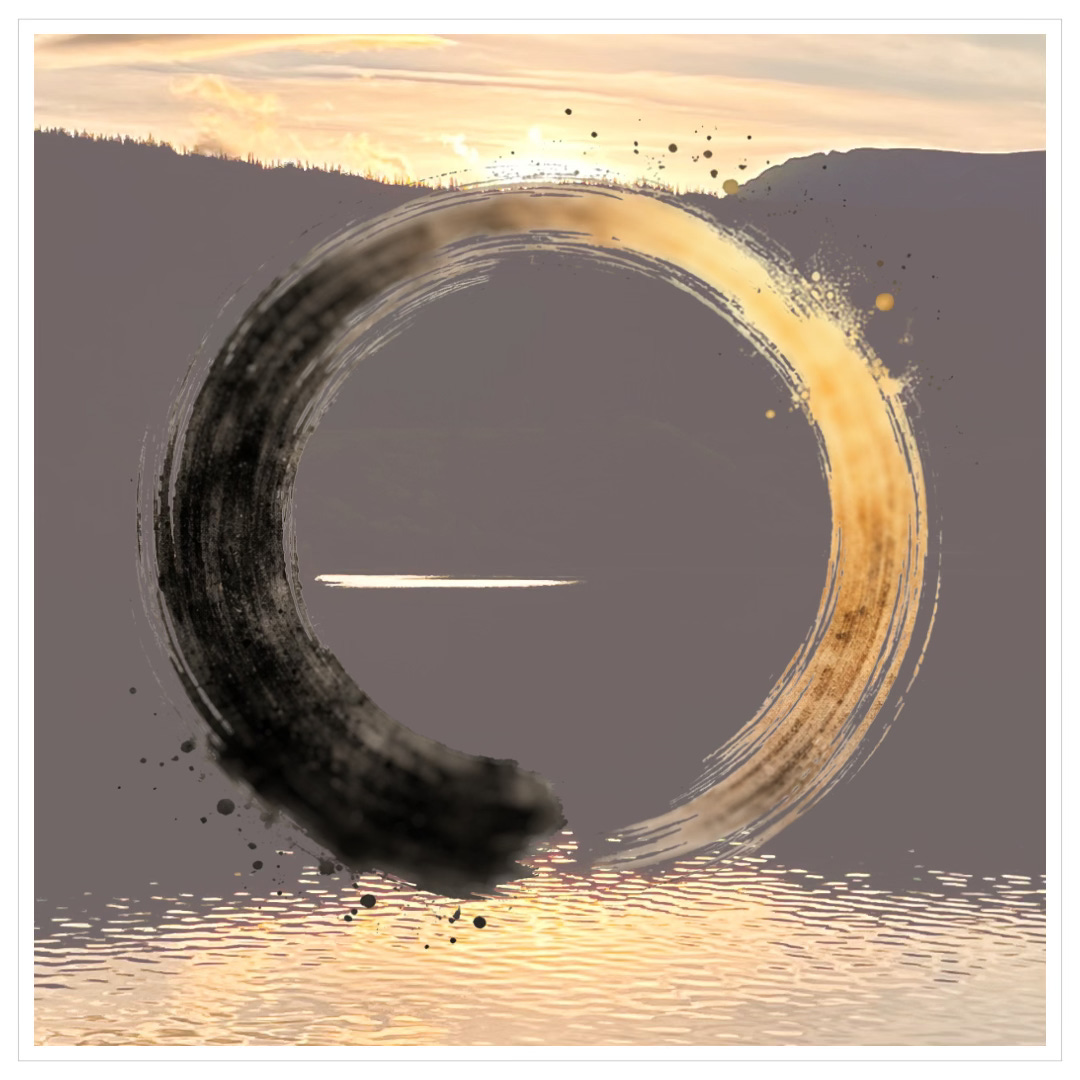
The gesture of drawing a circle might be seen as the likeness of a long journey that completes itself. It is not a forward line, which would promise progress. Nor is it even a spiral, which would suggest development. It is a circle, emblematic of neither, a stand-in motion for the journey of not yet. The single circle is a symbol of wholeness drawn out of the shards of fragmentation. It is an ingathering. It signals coherence.
Rising out of shattered madness, the first act is not speech in Celan’s poem. The first act is a gesture of form.
We can feel the abysmal depths of inner agony, the despair searching restlessly for the lantern of later. The narrator is groping through the dark not yet for the promise of the something that shall be. The arrival of this something already fills itself with you. This is the most ambiguous line of the poem. For the you is not yet known to the reader. Perhaps the you is the beloved; perhaps you is the reader; maybe you is God. Indeterminacy is as much in the you as in the something that shall be.
What will come may be a beginning. It may be an end. We don’t know. But hope persists. Hope persists because it already is. Hope was here before something shall be.
Rahamim refers to this as objectless hope: an “incessant striving towards something that has not yet become.”3 Rahamim’s objectless hope seems to suggest a dynamic that is as much ontological (structured in reality) as it is psychological. We read in his words those of Teilhard de Chardin, who writes in The Human Phenomenon that the nature of cosmogenesis is itself the ceaseless groping toward what is not yet.4
Do you see? If hope can arise without image, without object, without even a conceivable outcome, as it does in Celan’s poem, then it cannot be reduced to a purely psychological phenomenon unique to the human. It must be ontological, meaning, it must belong to the structure of reality, not a psychological construction superimposed onto reality. It must be a qualitative property, an essence, which is dynamic prior to being itself.
It is hard for us to imagine that a quality such as hope can exist before substance because we are so conditioned to understand existence as necessarily material. And with this comes the notion that qualities of existence are emergent faculties of material manifestations. We are flipping substance ontology on its head here, realizing essence before form.
Several weeks ago, when I introduced this series, I wrote:
“It began rather presciently with a few lines scribbled in my journal on the cusp of the New Year:
There must be hope intrinsic in the first flaring forth
There must be hope already in the birth of the universe.”
Was this ontological hope revealing itself before the long dark night?
Why would the infinite freedom of formlessness enter into the delimitations of form? Why would form arise at all unless something was already at work within the unformed? Some qualitative potency, what we might be inclined to call an originary Desire, must be ever pressing toward expression: something shall be.
And ontological hope is originary Desire tested through the travails of becoming, the ceaseless process of Being’s coming into being, in, through, and as the world.
What does this philosophical abstraction mean?
Simply put, we are saying that hope has been here all along. It does not emerge with the human. Nor is it a psyche-spiritual virtue endowed singularly to the human. We are suggesting that hope is intrinsic to cosmogenesis itself, an originary essence—a fragrance permeating the entire process of becoming. Hope is an intensity always already present.
It does not pass us by, dear Friends, even in the abysmal depths. It’s right here, always right here. And it does seem to require us as participants in human evolution. It needs to act through us and so needs our own enactment. Its anticipatory tension becomes taut in the agonies and sorrows of human existence. What we bear with ontological hope, we bestow our participation on behalf of becoming.
Perhaps the something that shall be is a trace of that deeper intensity, that potency which gives rise to the single circle we are here to draw out of fragmentation.

All Beyond the Comfort Zone letters and essays will always be free. Paid subscriptions and donations provide financial support for this publication and make it possible to keep all offerings accessible for everyone.
If you have the financial means to support this work, please consider offering a financial contribution today, with my deepest gratitude to you.

Notes & References
Asif Rahamim, “Später: Objectless Eschatology and Radical Hope in the Poetry of Paul Celan,” German Studies Review 47, no. 3 (October 2024), pp. 435–454. https://doi.org/10.1353/gsr.2024.a940190
Rahamim, “Später,” p. 437, cf. Paul Celan, Die Gedichte: Kommentierte Gesamtausgabe, ed. Barbara Wiedemann (Frankfurt am Main: Suhrkamp, 2014), pp. 363–364. English translation: Paul Celan, Breathturn into Timestead: The Collected Later Poetry, trans. Pierre Joris (New York: Farrar, Straus, and Giroux, 2014), pp. 363–364.
Ibid, p. 444.
Pierre Teilhard de Chardin, The Human Phenomenon, trans. Bernard Wall (New York: Harper & Row, 1959).
I find myself sitting in reverent silence after reading this. The vision of hope you offered — as ontological, intrinsic to the very movement of becoming — felt like a lantern quietly lit in the depths.
Your reflection on “something shall be” awakened a sense of participation for me: that hope is not something we wait for but something we enter into and enact. It felt as if you painted a circle we are invited to step inside together.
Thank you for shaping language that carries both tenderness and philosophical depth. I feel inspired. The illustration is gorgeous!
“It must be a qualitative property, an essence, which is dynamic prior to being itself.” This makes me wonder…is there any difference then between ontological hope and love? Or are the two sides of the same thing?