

Life Is in Me
Impressions, Perception, and Presence

Dear Friends,
It’s Saturday that I begin writing to you, as has been so most weeks since an intimate circle—fourteen of us—began a twelve-week journey of “Awakening to the Heart.” And every week, I hope to bring all of you into the outer folds of that inner journey, which, in these Sunday installments, seems to be coming about more as a compilation of passages scribed into my journal than as anything fully formed. This is so today.
Sri Aurobindo’s passage on feeling—which I shared with you here some weeks ago—has been pulsing through my morning reflections for many weeks. For Aurobindo, feeling is a “perception of something felt, a perception in the vital or psychic or in the essential substance of consciousness.”1 I hear in Aurobindo’s words intimations of G. I. Gurdjieff on impressions, that something felt imprints on awareness itself, indeed, on the very substance of our being. It is, first and foremost, our presence to that which impresses upon us—be it a fragrance, the glint of light from an ink-dark moon, an abyss of sorrow—that has the power to transform our way of being and invoke our active participation in the unfolding of consciousness.
Today’s passages are breadcrumbs on this long trail of wonderment on perception, feeling, and awakening to the heart.
In wonder,
Renée

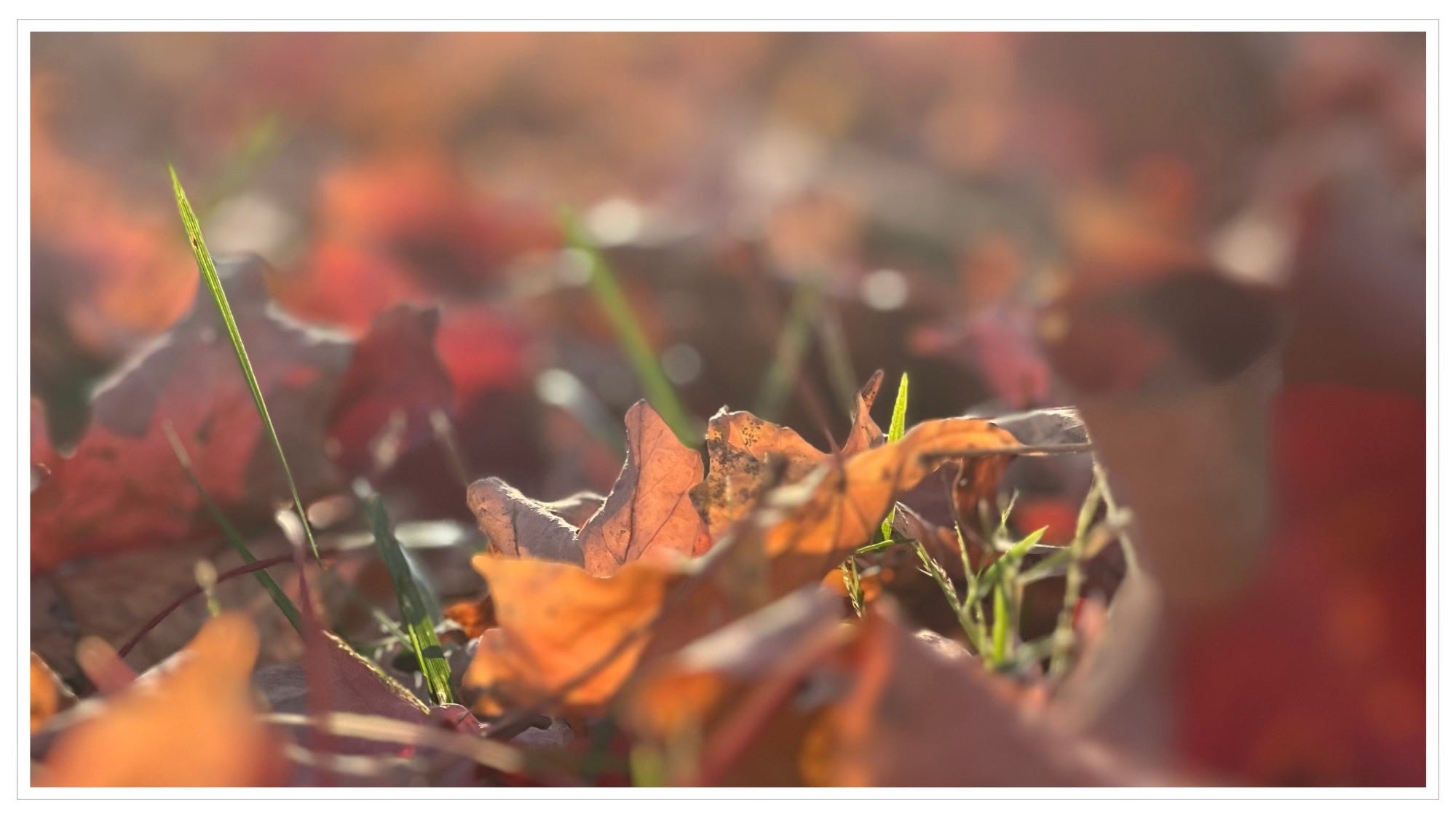
15 October. Yesterday, a maple leaf, soft apricot, a cartography of deep green veins. I pick it up, carry it two and a half miles home. In the night, it folds into itself. Reading [Madame Jeanne] de Salzmann, "I Need Impressions of Myself.”2
Gurdjieff spoke of impressions as food, but we do not understand what it means to feed ourselves or its significance for our being.
. . .
We think of impressions as lifeless, fixed like a photograph. But with every impression we receive a certain amount of energy, something alive that acts on us, that animates us. I can feel this when I have a new impression of myself, an impression entirely different from the way I usually experience myself. I suddenly know something real in quite a new way, and I receive energy by which I am animated.
17 October. Misty fog, thick in the air, a sense of something there. Reading de Salzmann, “I Am Asleep.”3
We wish to live, to be in life. From the moment we are born, something in us seeks to affirm itself in the outside world.
. . .
Who am I? I need to know. If I do not know, what meaning does my life have? And what in me responds to life. So, I must try to answer, to see who I am. First, my thought steps back and brings suggestions about myself: I am a man or woman who can do this, who has done that, who possesses this and that. My thinking volunteers possible answers from all that it knows. But it does not know what I am, does not really know me in this moment. Then I turn to my feeling. It is among the centers most capable of knowing. Can it answer? My feeling is not free. It has to obey the 'me' who wants to be the greatest, the most powerful, who suffers all the time from not being first. . . .
19 October. Sunday rain, slate gray is the sky; browned butter are the edges of falling leaves, those on trees flutter in the breeze like valves of the heart stirred with feeling. Reading de Salzmann:4
There is in me something very real, the self, but I am always closed to it, demanding that everything outside prove it to me. I am always on the surface, turned toward the outside in order to take something or to defend myself. Yet there is perhaps another attitude, another disposition, which I have nothing to take. I have only to receive. I need to receive an impression that nothing outside can give me—an impression of being, of myself having a sense, a meaning. The movement of knowing is a movement of abandon. It is necessary to open one’s hands.
20 October. The upper crowns of some trees are now without leaves, outstretched skeletons in the sky, naked with winter not yet. I pick up [Maurice] Nicoll. “The Digestion of Impressions.”5
[I]mpressions are the highest food that we take in and therefore the most important. It has often been said that everything you see, everything you hear, the people you know, the books you read, enter as impressions. Other people are impressions to you. You touch them, you see them, you hear them, and so on.
. . .
[T]he transformation of impressions is exactly comparable with the transformation of food in the stomach.
. . .
Let us take an example: Someone speaks to you in a way that you do not like – you feel all the mechanical reactions arising in you, you feel how you dislike this person and so on. Now suppose that you identify with all those typical mechanical reactions . . . so that you say, 'I can't stand this', or 'I can't bear this', or 'I dislike so much this kind of person who looks like this, behaves like this', and so on. Well, of course, if this happens, you are not transforming impressions. . . .
21 October. A month into autumn, first cold morning, a fire burning somewhere. Nicoll again on “The Digestion of Impressions.”6
Of course if you take this life and all that happens in it as the only thing and have not an idea that there is anything else, you will never be able to transform impressions.
23 October. This morning, leaving the bookmarked page of de Salzmann, I am flipping through the rest, searching for something. I do not know what. Then comes “Life is in me.”7
In the beginning, sensation is almost the only instrument for self-knowledge. It can give a power to watch over many things and to repeat experiences that we can then identify. This creates an inner world. Later, consciousness will have a deeper interior. Yet the impulse to look into the depth of oneself is an indispensable step in the evolution of consciousness.
. . .
I see that I never allow an experience to take place in myself. I always resist the full experience. This is because I want to lead it. I do not trust the experience. I trust only me. Because of this, it does not transform me. When I begin to perceive a subtle Presence in myself, I feel it as something alive that calls for its action to be felt. But I cannot feel its action deeply because I am separated from it by a wall of tensions, that is, of my mental reactions.
. . .
More and more I feel the need to experience certain impressions. This need is very strong, as though I could not live without these impressions . . . and, in fact, I cannot participate in a certain life without them. Indeed, the need is so strong that, for lack of impressions, I seek outside myself the shock that has to come from within. Life is in me, but I cannot feel its vibrations. They are too fine, too subtle for what I am now. Even my desire to be penetrated by these vibrations, to absorb them, brings duality and a tension that holds back the energy. With this tension I cannot become conscious of the nature of this energy. Its vibrations do not reach me. I feel this, I feel my incapacity. I am unable to be transformed. In my tension I feel my refusal. Life is here, very near, but my 'I' is still closed, turned in on itself.
Reading [Valentin] Tomberg.8 It is as if he comes with a response.
The heart perceives diverse presences as impressions and nuances of spiritual warmth.
. . .
Dear Unknown Friend, be attentive to your heart and towards the nuances of intimate spiritual warmth which arises from its depths!
Gatherings in Silence
NEXT GATHERING: Sunday, November 2, 12–1:30 pm ET
1/2 hour meditation in Silence followed by reflective conversation
These gatherings are an online sanctuary from the noise of the world and a homecoming to presence.
All are welcome.
If you would like to join and have questions, please email me: reneeeliphd[AT]gmail[DOT]com.
To keep the sanctuary an intimate experience, ‘seats’ are limited. Please email me for the Zoom link.
Inner-Life Work in the Spirit of Anam Cara


Notes & References
Sri Aurobindo, The Integral Yoga: Sri Aurobindo’s Teaching and Method of Practice (Twin Lakes, WI: Lotus Light Publications, 1993), p. 173.
Jeanne de Salzmann, The Reality of Being: The Fourth Way of Gurdjieff (Boulder, CO: Shambhala, 2011), p. 33.
Ibid., pp. 9–10.
Ibid., p. 39.
Maurice Nicoll, Psychological Commentaries: On the Teaching of G. I. Gurdjieff and P. D. Ouspensky, Vol. 1 ( London: Stuart & Watkins, 1970), p. 336.
Ibid., p. 340.
de Salzmann, Reality of Being, pp. 210–211.
Valentin Tomberg, Meditations on the Tarot: A Journey into Christian Hermeticism, trans. Robert Powell (New York: Jeremy P. Tarcher, 1985), p. 334.
Renée; if Rumi couldn't figure out "who I am", perhaps we're not meant to truly know; but we must investigate, as you say and know, for the mystery draws us toward it. How could we not search for the truth; living in a body, having a mind, being conscious, and living on this ball we call earth, moving through the vastness of the universe at unbelievable speeds?! Here is Rumi trying his best: "All day I think about it, then at night I say it. Where did I come from and what am I supposed to be doing? I have no idea. My soul is from elsewhere, I'm sure of that, and I intend to end up there. This drunkenness began in some other tavern. When I get back to that place, I'll be completely sober. Meanwhile, I'm like a bird from another continent, sitting in this aviary. The day is coming when I fly off. But who is it now in my ear who hears my voice? Who says words with my mouth? Who looks out with my eyes? What is the soul? I cannot stop asking. If I could taste one sip of an answer, I could break out of this prison for drunks. I didn't come here of my own accord, and I can't leave that way. Whoever brought me here, will have to take me home. This poetry; I never know what I'm going to say. When I'm outside the saying of it, I get very quiet, and rarely speak at all." And maybe that's a clue: silence; quieting the mind; and ultimately being ok not truly knowing "who I am". For me, the fact that I can feel love is enough sometimes.
"'I see that I never allow an experience to take place in myself. I always resist the full experience. This is because I want to lead it. I do not trust the experience. I trust only me. Because of this, it does not transform me. When I begin to perceive a subtle Presence in myself, I feel it as something alive that calls for its action to be felt. But I cannot feel its action deeply because I am separated from it by a wall of tensions, that is, of my mental reactions.'"
Ah, quoting a quote--is there a more ironic example of mental reactions strengthening a wall of tensions?
Thank you, dear Renée, for your wisdom and for culling from other wisdom keepers who shine light through the ego/intellect-generated impediments on the path into my heart.